
Amazon Advertising: The Definitive Guide
Not the console tour. This is the operating doctrine from running the channel, with our own page-one data underneath it: why every ACoS target is a dial you move rather than a number you pick, when losing money on a sale is buying an asset, where the ads actually sit on page one, who is really buying those slots, and the flywheel that, run long enough, leaves you a higher floor than you started from.
The machine, and whose side it is on
Amazon advertising is one machine with several surfaces: sponsored ads (the auction for search and detail-page real estate), display and streaming bought through DSP, and AMC, the clean room where exposure meets outcome. Underneath all of it is the retail engine the rest of this library covers: the listing that converts, the reviews that gate, the rank that compounds. Advertising is not adjacent to that engine. It is a way of buying its inputs.
That is easier to hold onto with the specific prompts named, because each one is a real recommendation you will see this week, and each one resolves to the same request.
| What it shows you | What it is selling | How to read it |
|---|---|---|
| Suggested bid | A higher bid. | Auction weather. It reports what other people are paying, which is not evidence about what a click is worth to you. Your ceiling comes from chapter 10's identity. |
| Lost impression share | More budget, and a higher bid to spend it. | A true fact with no economics attached. Impressions you did not buy were not necessarily impressions worth buying; the metric cannot tell the difference and is not designed to. |
| Recommended daily budget | A bigger cap. | A throttle recommendation from the party that profits from the throttle opening. Budgets are a finance instrument, per chapter 11. |
| Growth opportunities | New campaigns, new targets, new spend. | A to-do list somebody else wrote against somebody else's objective. Some entries are genuinely useful; none of them know your margin. |
| Budget rules and auto-apply suggestions | An automated increase you approve once and stop seeing. | A judgment dressed as an execution. Chapter 18 draws that line; this is the exact place it gets crossed quietly. |
One framing before the mechanics: it is impossible to be good at advertising in isolation. Ads convert against a listing, sell against a review count, and ship against an inventory position. An advertising decision made without unit economics, creative, and stock in the room is not a decision, it is a guess with a budget attached. That is also the honest warning about hiring ads-only help, which chapter 20 states plainly.
ACoS is a dial, not a number
The industry treats the ACoS target as a decision you make once. It is not. A target is set per product type, because unit economics differ, and per goal bucket, because the value of a sale differs by bucket. Then it moves, continuously, in response to whichever limiting factor currently binds.
| limiting factor | what you see | the dial | what you are optimizing for |
|---|---|---|---|
| Budget binds | campaigns go dark mid-day; you cannot buy all the traffic you want | tighten | rationing: only the best-converting traffic survives the day |
| Organic rank rises | you now hold top-of-search organically on the term you are also buying | tighten | the ad intercepts more than it causes; the same sale is worth less |
| Rank is the goal | a launch, a relaunch, or a climb with a defined finish line | loosen | buying rank, ratings, or customers: a slotting fee on a clock |
| Bids outrun margin | the math says 20% but the auction will not clear there at any volume | decide | an explicit choice: thinner margin, or an underspent budget |
Walk the first row, because it is the one that reverses most people's instinct. Say the goal is breakeven and the math says 30%. The campaigns spend through the budget and go dark at two in the afternoon. The correct move is to lower the target to 20%. When you cannot buy all the traffic there is, the dial stops being a profit setting and becomes a rationing mechanism: it keeps the best-converting traffic and lets the budget survive the day. Raising the budget instead is a decision about the business; tightening the dial is a decision about the traffic, and it is usually the one available today.
The second row is where advertising meets its own success. As your organic rank climbs to the top of the page, the ad above it intercepts more and causes less: the shopper was about to find you anyway. Same ad, same term, same ACoS, less value. Your own rank is therefore an input to your own targets, which is why the incrementality signals in chapter 15 feed directly back into this chapter's dial.
The two metrics are not rivals; they have different jobs
The dial needs to know where zero is, and zero is your contribution margin: breakeven ACoS equals the share of each sale left after cost of goods, fulfilment and referral fees. Thirty seconds of arithmetic, done once per product, immunizes every decision downstream.
The slotting fee
In physical retail you pay a slotting fee for shelf placement: an acknowledged, budgeted cost of buying position. Amazon has slotting fees too. They just arrive dressed as a terrible ACoS, and failing to recognise them kills more launches than any other accounting error.
Two frames make the spend legible. The first is lifetime value: if the average customer buys five units, the first sale is one fifth of the relationship, and losing money on it can be profitable across the whole. The second is the moat: on a launch the binding constraint is usually ratings, and our own page-one tracking puts the median review count on a competitive shelf in the thousands. Bought velocity is how a new ASIN accumulates ratings fast enough to clear the bar, and a rating bought that way is not spend, it is enterprise value accruing to the ASIN.
The instinct that a first order can carry “200% and change” turns out to be arithmetic. If lifetime contribution margin has to cover the acquisition cost, then max first-order ACoS = contribution margin % × expected lifetime units, less whatever margin you want to keep. At a 42% margin and five units, the ceiling is about 210%.
Where the ads actually are
Before deciding what to pay for a slot, it is worth knowing where the slots are. Everyone quotes a single ad-load number, ours is 25.6% of page-one slots, and the number is nearly useless on its own, because the ads are not spread evenly down the page. They cluster in blocks.
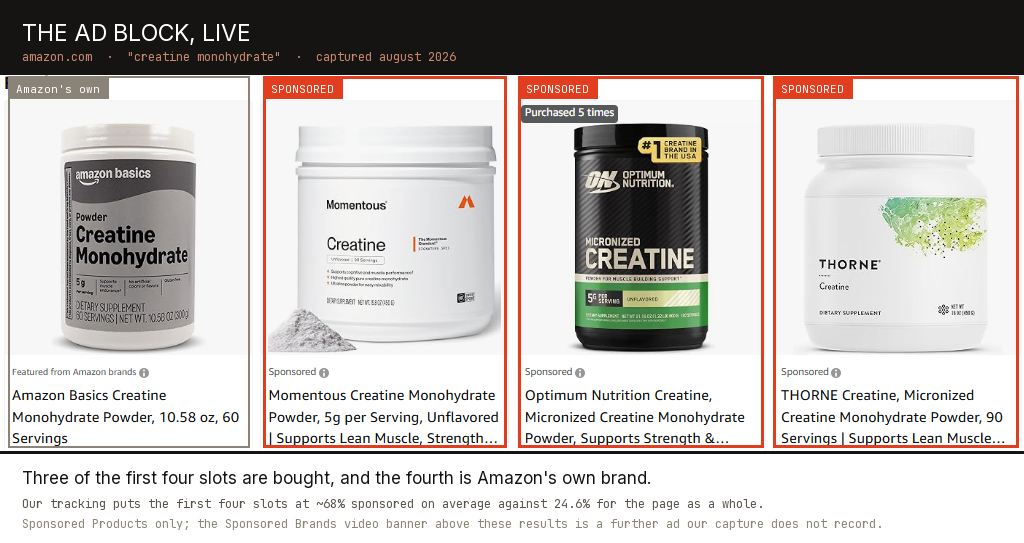
Three readings an operator can use immediately. The first four slots run about 71% sponsored against a page average of 25.6%, so roughly seven in ten of the slots a shopper sees first are bought, and ranking there organically means holding the most contested ground on Amazon.
Then comes the part worth knowing precisely, because it is narrower than it looks. The trough is positions five, six and seven, at 9-11% bought, and that is the whole of it. Those three slots are roughly nine-tenths organic, they inherit the scroll momentum of the block above them, and almost nobody is bidding against them: the cheapest high-attention real estate in the store, three slots wide.
And then it closes, fast. Positions eight through ten run 40-47%, and eleven and twelve jump back to 67-69%. This is the reading most guides miss, because the intuition that page one gets cheaper as you scroll is simply false: the shelf goes contested, open for three slots, then contested again. A shopper who rejected the first screen and kept going is landing in a second ad block, in a more deliberate frame of mind than the one they had at position 1, which makes that block worth a different bid rather than a cheaper one.
Ad load is also fairly stable across categories. Among our most-observed keywords it runs from about 22% to 38%, with the supplement terms clustered tightly around 23-27% and air fryer the outlier at 38%. The auction fills a broadly similar share of the shelf regardless of category; what differs is who bothers to bid.
| placement | ad types | bid control | what to know |
|---|---|---|---|
| Top of search (first page) | Sponsored Products, Sponsored Brands | 0-900% modifier | the most contested block: our capture shows the first four slots ~71% sponsored |
| Rest of search | Sponsored Products | 0-900% modifier | reached modifier parity in 2024; the cheap remainder |
| Product pages | Sponsored Products, Sponsored Display | 0-900% modifier | your ad on somebody else's detail page, and theirs on yours |
| Amazon Business | Sponsored Products | separate modifier, compounds | B2B buyers, invisible in standard placement reporting |
| Off-Amazon publishers | Sponsored Products, Sponsored Display | no opt-out (SP) | Pinterest, BuzzFeed, Hearst and others since 2023 |
| AI shopping prompts | Sponsored Products, Sponsored Brands | no separate bid | auto-enrolled, billable since march 2026, Amazon writes the copy |
Placement is a bid decision, not a campaign decision
Who buys the slot
The second question our tracking can answer that the console cannot: what kind of brand is behind a sponsored slot? We compared every sponsored slot against every organic slot sitting on the same captured pages.
| organic slots | sponsored slots | the read | |
|---|---|---|---|
| Median review count | 1,981 | 731 | advertisers carry a third of the moat |
| Median price | $28.99 | $39.95 | and ask ~38% more for it |
| Average rating | 4.49 | 4.43 | no real gap: the gate is passed |
The advertiser carries barely a third of the review count of the organic shelf and asks roughly 38% more money, at a rating that is effectively identical, 4.43 against 4.49. That is the challenger's signature: unable to win the shelf on moat, unwilling to win it on price, buying the position instead. It is the market independently confirming chapter 3, and it should be reassuring the first time you run a launch at an ugly ACoS. Everyone in that block is doing some version of the same thing.
The companion finding is who those advertisers are relative to the page they appear on. In the july 2026 slice we classified brand by brand, 69.4% of sponsored slots were held by brands with no organic rank on that keyword at all, renting rather than defending. Renting is legitimate, it is how challengers sample demand, but it prices in forever-rent, and the flywheel case for advertising lives in the other 30%.
Three buckets
Every campaign gets exactly one job, and there are three jobs. Retention (CR) defends the shoppers and terms you already own: branded traffic, where the value of a defended sale is lower and the target is correspondingly tighter. Acquisition (CA)wins shoppers who have never bought you: non-brand traffic, the growth engine, whose target flexes from efficient to deliberate slotting-fee spend depending on the quarter's goal. Discovery (DISC) finds new search terms and ASINs to target: a research budget, judged by what it graduates.
Defend the shoppers and terms you already own.
Win shoppers who have never bought you. The growth engine.
Find new search terms and ASINs worth targeting.
The common industry split is brand versus non-brand, which is roughly Retention versus Acquisition. What it misses is the third bucket, and the third bucket is what makes the harvesting story work: without a named research budget, discovery gets judged by profit metrics and quietly paused, and the account's keyword set freezes at whenever somebody last did research. The structure is deliberately boilerplate. It is not clever; it is the thing that makes day-to-day management, delegation and intelligent discussion possible.
The buckets are set per product type, because margins and the value of a sale differ, and each carries its own dial from chapter 2. Cross them with ad format and targeting type and you have the whole account, and a naming convention that writes the coordinate into every campaign name means anyone who knows the system can read the account from the campaign list. Anything that will not resolve to a bucket goes in one pen, to be classified or killed monthly.
Top of search is a modifier
Top of search is not a fourth bucket. It is a placement decision layered onto Retention or Acquisition, and keeping that straight prevents two expensive errors.
The first is judging it by the wrong scoreboard. Top-of- search spend serves share of voice, impression share and organic rank improvement, not pure cost per acquisition, so measuring a top-of-search carve-out against the acquisition bucket's efficiency math guarantees you kill it exactly when it is working. The second is forgetting it has a flavour: top of search can be defensive, owning the top of your own brand's page during a siege, or offensive, buying the shelf's premium placement to build rank. Those deserve different targets, and per chapter 4 they are bidding into a block that is already about 71% bought.
The arithmetic underneath is worth seeing, because it is genuinely ambiguous rather than obviously good. The premium placement costs more per click and converts better, and those two facts do not cancel cleanly:
| rest of search | top of search | |
|---|---|---|
| Cost per click | $0.90 | $1.80 |
| Click-through rate | 0.35% | 0.80% |
| Conversion rate | 9% | 14% |
| Revenue per click (at $40 order) | $3.60 | $5.60 |
| ACoS on those clicks | 25.0% | 32.1% |
32.1% against 25.0%. Judged on efficiency alone, top of search loses and gets cut.
more than double the click-through at a higher conversion rate: far more sales from the same impressions.
the extra volume buys velocity and rank, so total sales can grow faster than the spend does.
Every permutation exists in real accounts. Sometimes the higher conversion rate more than covers the higher click cost and top of search is simply better on every measure. More often it looks like the table above: worse on ACoS, much better on volume, and better on TACoS once the velocity it buys starts feeding rank. Occasionally the conversion lift never materialises and the premium is wasted. The only way to know is to read the placement report for your own terms, which is why the modifier exists at all.
Harvesting
Discovery's job is finding new search terms and ASINs to target, nothing else. Auto and broad campaigns sample Amazon's own matching against real spend, which makes them the only keyword research that samples actual shoppers paying actual money; everything else is a proxy. The pipeline: Discovery surfaces terms, a maintained brand list classifies each proven term as branded or non-brand, and graduation creates it as an exact target in Retention or Acquisition while negating it in Discovery in the same motion, so the mine never pays twice for ore it has already assayed.
Two orders graduates a term
Discovery spend should shrink over time
Which means the budget mix itself has a shape over time. A new account needs a large research allocation because it knows nothing; a mature one has already found its terms and negated its dead ends, so discovery shrinks while acquisition holds and retention grows, because there is simply more brand demand to defend than there was at launch. The percentages below are illustrative, but the direction is not optional.
terms get found and dead ends get negated, so the research budget stops needing to be large
it stays the engine: the share moves, the job never does
there is simply more brand demand to defend than there was at launch
Negation is the other half of the discipline. Exact negatives remove one term; phrase negatives remove whole families and can amputate a category of demand if used carelessly. Keep the non-performance negations human-reviewed, because attribution lag makes young data lie, and a term that looks dead on Tuesday can have orders arriving through the following week. An account's negative lists are its accumulated learning; treat them as an asset with the same seriousness as the keyword list.
The audience matrix
Audience targeting on Amazon is the most misreported subject in the category, because the answer is genuinely fiddly: the same audience feature behaves differently depending on which ad type you are running it in. Here is the whole thing in one table.
| capability | Sponsored Products | Sponsored Brands | Sponsored Display | Streaming TV |
|---|---|---|---|---|
| Views remarketing | no | no | yes | no |
| Purchases remarketing | no | no | yes | no |
| Amazon audiences (in-market, lifestyle, interests, life events) | no | no | yes | yes |
| Contextual targeting | no | no | yes | n/a |
| Amazon-built audiences as a bid boost | no | bid boost only | n/a | n/a |
| AMC custom audiences as targeting | no | no | yes | n/a |
| AMC custom audiences as a bid boost | bid boost only | bid boost only | n/a | n/a |
The row that matters most: AMC custom audiences are real targeting in Sponsored Display, but only a bid adjustment in Sponsored Products and Sponsored Brands. In search you still target by keyword or product, and audience membership only changes what you are willing to pay when that shopper shows up. Anyone describing an “audience-targeted Sponsored Products campaign” is describing something that does not exist.
Once you can target audiences, the harder question is which ones deserve the money, and the answer runs opposite to what the reports will tell you. Audiences sort along a spectrum from cold to warm, and warmth is inversely related to how much credit an ad actually deserves:
This single figure explains most of the disagreements between advertising teams and finance teams. The lines at the bottom of the spectrum, retargeting and branded search, report the best returns in nearly every account and contribute the least new revenue; the lines at the top do the real acquisition work and look worst on a dashboard. None of that makes the warm lines worthless, defending and recovering carts is real work, but it does mean the ranking of campaigns by reported return is close to an inversion of their ranking by contribution.
The practical consequence is a sequencing rule. Audience sophistication belongs where audiences are actually targetable: Sponsored Display for remarketing and Amazon's in-market and lifestyle segments, streaming for reach against interest and life-event audiences, DSP for the full library. In search, audiences are a refinement on top of keyword strategy, not a replacement for it. Sponsored Brands does carry bid adjustments for its own audiences, including shoppers who previously purchased your brand or added it to cart, which is a cheap and underused lever because it costs nothing to configure and only bites when the shopper is already warm.
Bids: the identity, validated
One identity underlies every bid decision. ACoS on a click is spend over expected sales, which is CPC divided by (CVR × AOV). Rearranged: the highest CPC you can pay at a target ACoS equals target × CVR × AOV. At a 30% target, a term converting at 10% with a $35 order supports a $1.05 CPC. Because auctions clear below the bid, the bid sits above that by whatever bid-to-clear ratio you observe.
We validated the identity before publishing it. It holds, and the four caveats are where the actual skill lives.
It is an expectation, so confidence gates the move
CVR is a function of placement, so the curve bends
AOV means attributed order value
The V is a doctrine choice
Budgets: never out, never the throttle
With bids doing the steering, budgeting becomes what it should have been: a finance instrument rather than a throttle. Bids ration toward your best traffic; caps sit underneath as a fail-safe. Which is why you should never be running out of budget: the dark afternoon in chapter 2 was not overspending, it was over-bidding, and the fix was the dial rather than a bigger cap. TACoS sets the envelope at the P&L level. The envelope cascades to product groups and then to buckets, because Retention, Acquisition and Discovery are different investments with different rules. Pacing tracks the month as a curve rather than a line, weekends and paydays weighted, with an adaptive daily target, remaining budget over remaining days, that absorbs reality as it happens.
Set once at month start from day-of-week and day-of-month weights, and never changed. It is what you meant to do.
Recomputed daily as remaining budget over remaining days. It is what you must now do, given what already happened. The gap between the two is the whole story of the month.
Pacing hot has an exchange rate, and it is worth carrying in your head: in a 30-day month, every 3% you run over plan is roughly one day out of budget at the end of it. Six percent hot is two dark days, nine percent is three. That is what makes a pacing number urgent rather than administrative. It is not a tidiness metric, it is the calendar telling you which days in the last week you have already decided to sit out.
Two alerts earn an interruption. A campaign capping out while performing under target is declining profitable demand every capped hour: the most expensive quiet failure in ad operations, and by the rule above it should be nearly impossible in a well-run account. And a bucket underspending its plan by half means the plan and the account have diverged, either because the auction got expensive, which is the margin-versus-underspend decision from chapter 2, or because the structure has a hole.
Creative is half of advertising
Every mechanism in this guide terminates on a click that lands somewhere, and the somewhere decides everything. The flywheel turns on purchase rate. The bid identity multiplies by conversion rate. The slotting fee only converts into rank if the page converts into sales. Advertising strategy that has not read the creative doctrine is incomplete on its own terms.
Your main image is your most-viewed ad creative
Above Sponsored Products, creative becomes a real production discipline with real constraints. A Sponsored Brands unit is not one asset but five, and each one is a separate decision:
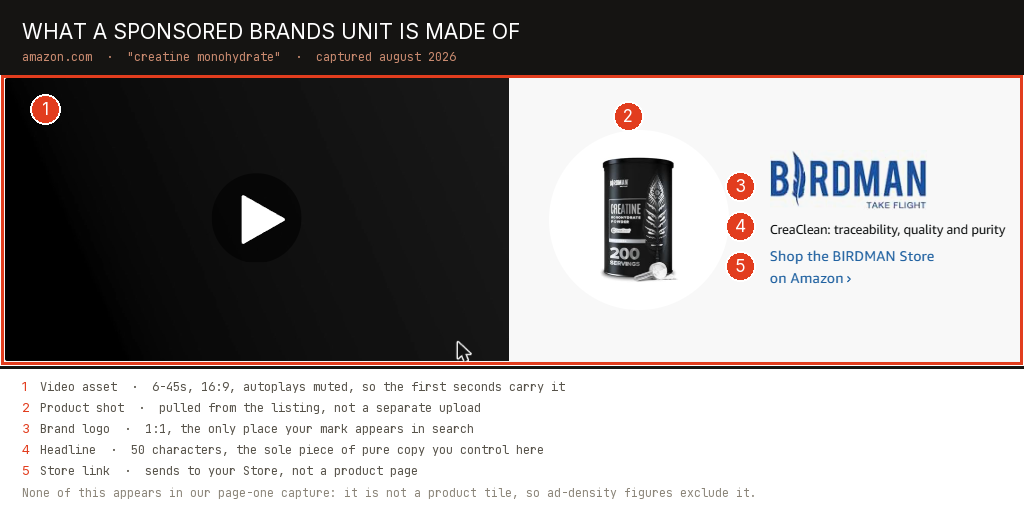
The specs below are the ones that actually bite in production; confirm against Amazon's spec pages before a shoot, because they move.
| surface | the specs that bite | the craft note |
|---|---|---|
| Sponsored Brands | headline 50 characters · logo 1:1 from 400×400 · custom image square 1200×1200, wide 1200×628 | the headline is the only pure copy asset in Amazon search |
| Sponsored Brands video | 6-45s (20s or less recommended) · 16:9 · 1280×720 to 4K · ≤500MB · H.264/H.265 | muted autoplay: the first two seconds carry the whole message |
| Sponsored Products video | 1-5 feature videos per ASIN; shoppers see up to three, chosen by query relevance | added to existing campaigns; no new campaign type |
| Sponsored Display | headline 50 characters · logo from 600×100 · responsive image 1200×1200 / 900×1600 / 1200×628 · video ≤45s | one image upload generates thousands of size variants |
| Streaming TV / Prime Video | 15/30/45/60s US · min 1920×1080 · 16:9 · ≤500MB · high bitrate | lengths vary by supply source; check per placement |
| DSP display | 300×250 · 728×90 · 160×600 · 300×600 · 970×250 · 320×50 · 40-200KB | responsive eCommerce creative auto-pulls price, deal, rating, Prime badge |
| Audio | 10-30s · ≤3MB · companion banner 1024×1024 · headline 19 characters | no click-through language: smart speakers have no screen |
Video is now inside Sponsored Products, not just above it
The AI creative tools are free, and that cuts both ways
DSP and the screens
Amazon DSP is programmatic display, video and audio bought on audiences instead of search terms, across Amazon's own properties and a large and rapidly growing pool of third-party supply. It is the part of the channel where the most money is wasted per hour of attention paid to it, and the reasons are structural rather than moral: the reporting flatters itself, the inventory is invisible unless you go looking, and the people selling you access have their own reasons for how they frame the entry price.
The minimum that is not a minimum
You will be told DSP requires a large minimum spend. Figures between thirty-five and fifty thousand dollars circulate as though they were platform rules. They are not. There is no minimum spend that gates the technology. What those numbers actually describe is the commercial convention of managed service, and, more often, the floor a particular agency requires to make your account worth staffing. That is a reasonable business decision on their part and a terrible piece of information for you, because it gets repeated as if Amazon set it.
The attribution problem, which is the real barrier
The reason DSP deserves caution is not its price. It is that DSP has an enormous tendency toward inflated attribution, and the inflation arrives pre-installed in the default reporting. Search advertising flatters itself too, mostly through branded interception, but display and streaming flatter themselves harder because they run on impressions: a person who never clicked anything can be credited with a purchase they were going to make anyway.
| View-through credit1 | An impression nobody clicked is credited with the sale. Display and streaming run on impressions, so this is the largest single source of inflation, and it is on by default. | the check Separate click-attributed from view-attributed in every report before you read it. If the campaign only works with views included, you have not found a channel, you have found a counting convention. |
| Audiences that were converting anyway2 | Retargeting people who already viewed your detail page, or in-market segments for a category you already dominate, buys credit for demand you had. The broader and warmer the audience, the better the report and the weaker the causation. | the check Judge prospecting and retargeting on separate lines, never blended. Ask what share of conversions are new-to-brand; a retargeting line with low new-to-brand share is a receipt printer. |
| Inventory you never inspected3 | Programmatic buys thousands of placements you did not name. Some are premium video; some are a banner nobody saw at the bottom of an app. Both report impressions identically. | the check Pull the placement and domain report and read it like a bank statement. Exclude what you would not have bought deliberately, and keep excluding: the list is never finished. |
Put those three together and a campaign can report a handsome return while contributing almost nothing, and the failure mode is not that somebody lied. It is that nobody asked the reported number what it was made of. Asking is a mechanical exercise: strip one layer at a time and watch what survives.
Every step down that ladder is a question the default report does not ask on your behalf, and the last bar is the only one that corresponds to money the business would not have made anyway. Run the decomposition before a renewal, not after. This is the surface where the incrementality discipline from chapter 15 stops being an intellectual exercise and becomes the difference between a channel and a subscription.
Know what you are buying: targeting and inventory
Two competences separate DSP that works from DSP that merely spends. The first is knowing your targeting precisely: which audience, built how, refreshed how often, and whether the tactic is prospecting into new demand or harvesting demand you already created. Amazon's goal-based products complicate this in a way worth stating plainly, because it is easy to misread: when you attach your first-party or clean-room audiences to an automated conversion-optimizing campaign, those audiences generally act as optimization signals rather than hard targeting constraints. The system is being pointed, not fenced. That is powerful when the system has enough conversions to learn from, and it is how budgets quietly leak into audiences you never intended to buy when it does not.
The second is knowing your inventory: where the impressions physically ran. Programmatic buys placements you did not individually approve, and the spread inside a single campaign runs from premium streaming to the bottom of an app nobody scrolls to. The supply pool has also changed faster than most published guidance, and it has changed enough that it is worth seeing whole rather than as a list of names in a sentence.
- Prime Video
- live sports rights
- Twitch
- Fire TV
- IMDb
- Amazon.com
- Amazon Music
- Alexa
- Roku · jun 2025
- Disney · jun 2025
- Netflix · sept 2025
- SiriusXM · sept 2025
- Spotify · oct 2025
- iHeart · nov 2025
- exchange display
- in-app inventory
- online video
- the placements you did not name
The middle two columns are the story. Every one of those deals was signed inside five months of 2025, which means a plan written from a 2024 understanding of DSP is planning against roughly the Amazon-owned column alone. It also means the honest description of the product changed: this is a general streaming and audio buying tool that happens to have Amazon's retail signal attached, not an Amazon-inventory product with some extras bolted on. Which raises the stakes on the placement report considerably, because “where did it run” now spans four columns instead of one.
When it earns the next dollar, and how to judge it
Sequencing first: sponsored search should be structurally sound before DSP gets budget, because DSP's job is to create demand that search then harvests, and an account that cannot harvest efficiently will leak whatever DSP sends it. Once that holds, DSP buys the things search cannot: shoppers who are not searching yet, people who viewed and did not convert, past purchasers worth reactivating, and reach on screens. Streaming TV specifically is self-service in the console, which makes it the usual first step off the search shelf for a brand that wants screens without a commitment.
Judge it on a quarter, and not on its own scoreboard
One structural note for planning. The wall between DSP and sponsored ads is coming down inside the interface, with unified campaign management and unified reporting, which means the old organizational split, one team for search and another for programmatic, is becoming an artefact of the tooling rather than a fact of the channel. The measurement discipline, however, does not merge automatically. Keep reading the two apart until you have proven they can be read together.
The flywheel and the higher floor
Here is the mechanism that justifies every slotting fee. Organic rank is essentially a stack rank of relevance, and relevance, in practice, is purchase rate against the term. The more velocity an ASIN has on a term, the more data the algorithm has, and the more confident it can be ranking you. Top-of-search placements, paid and organic alike, carry the highest click and conversion rates. So buying top of search artificially improves your measured purchase rate exactly where the algorithm is watching, which buys velocity, which builds ratings, which narrows the moat between you and the incumbents ahead.
Run long enough, the loop lets a challenger catch up to entrenched competitors. It is expensive, and the physics cut both ways: stop, and you will likely fall. But sustain it long enough and you fall to a higher floor than you started from, because the assets the spend bought, the ratings, the review count, the accumulated purchase history, do not un-accrue. The flywheel is not a trick. It is buying permanent assets with temporary money, and the entire judgment is whether the floor you will land on is worth the fee you will pay to get there.
Which is also why this chapter sits next to the creative one. The flywheel turns on purchase rate, and purchase rate is the listing. Buying top of search for a page that does not convert is renting a stage for an act that is not ready.
Indicators of incrementality
Every dial in chapter 2 asks the same underlying question: would this sale have happened anyway? Attribution cannot answer it, because the last click takes credit whether it caused the purchase or merely stood nearest to it. But the answer is estimable, from a ladder of indicators that starts free and climbs as the budget justifies.
Your own organic rank on every term you pay for. Top-3 organic with an ad above it is mostly interception; no organic presence at all means the ad is the only way that shopper meets you. Plus branded versus non-brand decomposition of every report, before you read it.
New-to-brand share per campaign and per keyword: a first-ever customer is much harder to explain away than a repeat one. Repeat share, which is its complement. Halo onto products the campaign never advertised, which the campaign's own report will never show you.
New-to-brand rate by individual keyword, lifetime value by audience segment, the frequency curve that shows where additional exposure stops buying anything, and branded-search lift from upper-funnel spend.
Pause the suspect line for two weeks and judge on total sales and organic rank, not attributed sales. One variable at a time, calm weeks only, never through a deal window.
The cheapest rung is the most neglected, and our shelf data shows why it matters at market scale: about seven in ten sponsored slots are held by brands with no organic rank on the keyword. Renting is maximally incremental and maximally temporary; defending your own top-three organic slot is the opposite on both counts. Neither is wrong. Not knowing which one you are doing is.
Attribution: the fine print
Three mechanics corrupt more decisions than any strategy error. Windows: the same campaign has a 7-day, a 14-day and a 30-day ACoS, so an ACoS quoted without its window is not quite a number. Last-touch politics: credit flows to whatever is clicked last, which systematically flatters brand campaigns and starves discovery, and every branded-versus-non-brand comparison inherits that bias. Maturity:attribution back-fills for days, so recent data is always incomplete, and optimizing on yesterday's ACoS is optimizing on fiction.
The window question is less dramatic than it is usually made to sound, and the actual shape is worth internalising because it settles several arguments at once:
On an everyday consumable, roughly 97% of a click's conversions have landed within seven days and about 99% within fourteen; the thirtieth day is chasing a rounding error. So the choice between windows barely moves the number for most products, and teams arguing about it are usually arguing about noise. What the curve does settle is the maturity rule: a click is nearly finished converting after a week, which is precisely why acting on data younger than that means acting on an unfinished figure. Run weekly cycles on data at least seven days old.
The exception is real and predictable. High-consideration and higher-priced products stretch the tail, and for them the gap between windows is genuine rather than cosmetic. The diagnostic costs ten minutes: export your own 7, 14 and 30-day numbers and look at the spread. If they nearly agree, your shoppers decide fast and the short window is safe. If they do not, you have measured your own consideration period, which is more useful than any rule of thumb.
AMC: the maturity curve
AMC is Amazon's clean room: ad exposure and conversion events joined at the hashed-customer level, answering questions the console structurally cannot. What it is for, in this doctrine, is better decisions about incrementality, the new-to-brand rate of specific keywords, the lifetime value of specific audience segments, and the precision to optimize against customer acquisition cost and real incrementality instead of blended return.
What share of ad buyers are genuinely new, and what did each cost?
Blended return hides whether ads acquire or re-bill the base.
Do this month's new customers come back at 30, 90, 365 days?
Turns 'is a 40% ACoS acceptable' into arithmetic.
At what exposure count does conversion stop climbing?
The ceiling for retargeting and display pressure.
How much value lands on products the campaign never advertised?
Direct return versus full return: the gap reverses verdicts.
Which products actually captured the value of the spend?
Variation families make this non-obvious and material.
Which queries convert, with new-to-brand attached?
Harvesting decisions made with acquisition context.
The access story changed and most published guides have not caught up: AMC became free and self-service for sponsored-ads-only advertisers in September 2025, with no DSP spend and no partner required, and the lookback window has since roughly doubled. If your mental model is “AMC is for enterprise DSP buyers,” it is a year out of date.
The honest adoption rule is a maturity curve. For a new or immature brand the gap between AMC-informed decisions and instinct is small, because instinct is roughly right: someone searching a non-brand term has never heard of the brand that launched yesterday, so new-to-brand rates are high nearly everywhere and the clean room mostly confirms it. For a mature brand the gap is enormous: which keywords still bring genuinely new customers, which audiences actually repeat, where frequency stops buying anything. AMC is always of value; the marginal gain grows with the budget and the brand's maturity, and so should the investment in it. Its limits travel with every read: ad-exposed customers only, so pure-organic buyers are invisible; a bounded lookback; and small cells suppressed by design.
Where automation belongs
Most of what vendors sell as artificial intelligence in this channel is a rules engine, and that is fine, because rules are exactly right for the tasks worth automating. The useful question was never “is this AI?” It is “is this task a judgment or an execution?” Executions should run without you. Judgments should never run without you. Everything else in this chapter follows from that one line.
Bid changes automate | It is arithmetic against a target you set, run on a cadence no human can match. The judgment lives in the target, not the adjustment. | clamp the step size, run on data at least a week old, and log a reason on every change |
Search-term harvesting automate | A threshold test with no ambiguity: two orders and the term graduates. Waiting for a human to notice is pure decay. | the brand list that classifies the term is the part a human must maintain |
Negation automate | A term that has spent without converting is arithmetic against a threshold, the same as a bid. The judgment is where you set the threshold, not which term trips it. | exact negatives freely; clamp phrase negatives, which can amputate a whole family of demand, and run on data old enough that attribution lag has settled |
Budget pacing automate | Reallocating against a plan is bookkeeping. The plan is the decision; keeping to it is not. | alert on capped-while-performing, because that failure looks like success |
Dayparting prove it first | Pausing breaks the continuous signal the auction prices you on, and the restart can cost more than the saved hours were worth. | only where the conversion gap between best and worst hours is genuinely large |
Target ACoS, launches, price never | These are the business deciding what it wants. Automating them means the system chooses your margin and your strategy. | the dial in chapter 2 is a human's job, permanently |
The failure that does not announce itself
Ask what a tool ingests, not what it claims
What actually changed
Most Amazon advertising content on the internet describes a 2022 product. That is not a jab, it is an operational warning: several changes in the last year break playbooks that were correct when they were written, and two of them change numbers you are probably reporting to somebody.
| Jan 1, 2026 | View-through attribution changed The blanket 14-day view window was replaced with a model that judges whether a view actually influenced the purchase. Affects Sponsored Brands, Sponsored Display vCPM and DSP store inventory; click attribution is unchanged. The old basis survives as the all-views metric family: if your reported sales fell this year, check the metric before you blame the campaigns. |
| Mar 25, 2026 | AI prompt ads went billable Sponsored Products and Brands prompts on Amazon's AI shopping surfaces left free beta and became billable under your existing CPC bids. Auto-enrolled. You can pause individual prompts; you cannot write them. |
| Jun 8, 2026 | Unified reporting reached GA One report across sponsored ads and DSP, spanning accounts, countries and ad products. Legacy separate reports sunset Dec 31, 2026: anything built on them needs rebuilding this year. |
| Nov 2025 | Sponsored Products video shipped Video inside standard Sponsored Products, no new campaign type. |
| Nov 2025 | Reserve Share of Voice launched Buy guaranteed top-of-search on your own brand terms at a fixed price, upfront: a defensive instrument, priced like insurance. |
| Sep 18, 2025 | AMC went free and self-service For sponsored-ads-only advertisers, no DSP spend and no partner required. The lookback window later extended from 13 to 25 months, live in the US and Canada from November 2025. Most published guides still describe AMC as enterprise-gated. |
The reporting sunset at the end of 2026 is the one with a deadline attached. If your dashboards, exports or agency reporting are built on the legacy separate feeds, that is rebuild work with a fixed date, and it is the kind of thing that gets discovered in January rather than planned in August.
The operator's rules
Agencies showing off spectacular ROAS numbers are a red flag: it usually means optimizing to the wrong thing, most often branded interception dressed up as performance. The right ROAS is the one your goals and economics chose, and it is rarely the prettiest number available.
It is impossible to advertise well without inventory, unit economics and creative merchandising in the same conversation. Hire an ads-only agency and you, the point of contact, become the connective tissue between them; budget your own hours accordingly, because that job does not disappear by being unassigned.
Bids control daily spend; caps are the fail-safe underneath. Every dark hour hands your best traffic to a competitor who stayed on.
Amazon and Walmart's first priority is that you spend more, and the data they surface serves that end. Take their numbers as inputs, never as advice. Your targets come from your economics.
Want this doctrine run on your account, dials, buckets, pipeline and all? Work with us.
FAQ
What is a good ACoS on Amazon?
There is no good ACoS; there is a correct target for one product, in one goal bucket, this month, given its unit economics and its binding constraint. The target is a dial: it tightens when budget is the constraint or when your organic position makes ads less incremental, and it loosens when you are deliberately buying rank. Any guide quoting a universal number is selling you someone else's economics.
What is the difference between ACoS and TACoS?
Different jobs. TACoS (spend over total sales) is a P&L and budget-control metric: what advertising costs the business. ACoS (spend over ad-attributed sales) is an efficiency metric: how to optimize between campaigns, products and targets. Most reporting confusion is one being asked to do the other's job.
Is it ever right to run an unprofitable ACoS?
Yes, deliberately and on a clock. Think of it as a slotting fee. If a customer buys five units over their lifetime, the arithmetic ceiling on a first order is contribution margin times lifetime units, which on a 42% margin and five units is about 210%. The rule is that unprofitable spend must be buying a named asset: rank, ratings, or customers with known repeat behaviour.
Which Amazon attribution window should I use?
For most everyday products it matters far less than people assume: roughly 97% of a click's conversions land within seven days and about 99% within fourteen, so the three windows nearly agree. Pick one, name it beside every figure, and never compare across it. The exception is high-consideration and higher-priced products, where the tail is genuinely longer. Export your own 7, 14 and 30-day numbers and read the spread; that measures your actual consideration period.
How much of Amazon page one is ads?
Across 1.66 million page-one slots in our tracking corpus, 25.6% were Sponsored Products. They are not spread evenly: they cluster in blocks. The first four slots run about 71% sponsored, positions five through seven fall to 9-11%, and then the shelf closes again, with eight through ten at 40-47% and eleven and twelve back near 67%. The intuition that page one gets cheaper as you scroll is false; the open run is only three slots wide. That counts Sponsored Products only, so with brand banners included the true figure is higher.
When should a search term be graduated from an auto campaign?
Two orders. If a term converted twice, that is a strong indicator it will convert again, and if it converted twice while looking like the wrong intent, the intent read is probably wrong, not the term. Graduate it, negate it in the source, and expect discovery spend to shrink over time.
Can I target audiences in Sponsored Products?
Not as targeting. Sponsored Products has no native audience targeting or remarketing. AMC custom audiences can adjust your bid in Sponsored Products and Sponsored Brands, but only Sponsored Display can target an audience directly. This is the single most misreported fact in Amazon advertising.
Do Amazon ads improve organic rank?
Through one mechanism: organic rank is effectively a stack rank of purchase rate against the term, and top-of-search placements convert best. Advertising into them buys velocity and the ratings that velocity builds. Stop and you fall, but sustain it long enough and you fall to a higher floor than you started from.
Is there a minimum spend for Amazon DSP?
No. Minimums you are quoted are commercial conventions of managed service, and most often the floor a particular agency needs to make your account worth staffing, not a platform rule. What a small DSP budget actually costs you is scale and speed of learning: it takes longer to accumulate enough conversions to know whether a tactic works. That is a real constraint on the rate of learning, not a locked door.
Why do DSP numbers look better than they are?
Three reasons, all on by default: view-through credit hands sales to impressions nobody clicked; warm audiences like retargeting take credit for demand you already created; and programmatic buys inventory you never inspected. Separate click from view attribution, judge prospecting and retargeting on separate lines, read the placement report like a bank statement, and grade the channel on total business outcomes rather than its own scoreboard.
Is AMC worth it for a mid-size brand?
More than most guides assume, because access changed: AMC became free and self-service for sponsored-ads-only advertisers in September 2025, no DSP spend required. The value still scales with maturity: a brand that launched yesterday learns little, while a mature brand learns which keywords bring genuinely new customers.
What should I automate in Amazon advertising?
Automate executions, keep judgments. Bid changes, search-term harvesting, negation and budget pacing should all run without you, with guardrails on step size and a reason logged on every change. Negation needs two of those guardrails specifically: run it on data old enough that attribution lag has settled, and clamp phrase negatives, which can remove a whole family of demand at once. Target ACoS, launches and pricing should never be automated: those are the business deciding what it wants.
How do I judge an Amazon ad automation tool?
Ask what it ingests and what it executes unattended, not whether it says AI. Genuinely hourly optimization is impossible without consuming Amazon's hourly data stream, so any intraday claim from a tool that does not is a scheduler running on stale numbers. Then ask which actions run without approval, and what the tool does when a product goes out of stock.